Instagram and WhatsApp sellers in Iraq: what they need to grow
Chat is the Iraqi merchant’s shop today. What gets lost in it, what a merchant needs to grow, and how that shaped the design of the Madar platform.

In short
- Selling by chat works because it is fast, personal and takes cash on delivery. It breaks down when orders multiply and get lost among the messages.
- A merchant needs five things to grow: an order with a number and a status, counted stock, delivery priced for each governorate, cash tracking, and a store link of their own.
- Any tool for a small merchant has to work from the phone, or they will drop it and go back to messages.
In this article
An Iraqi merchant picks up the phone in the morning and finds dozens of messages: a question about a price, a photo of a product, a customer’s location for delivery. That phone is their shop window, their order book and their accounts. One lost message is enough to lose a sale.
I know this picture well, because it is where the work on Madar, the online store platform, began. I will not talk about merchant results here, because there are none to report yet. What I can explain is the design decisions and the reasons behind them.
Why selling by chat works
I do not think a merchant who sells through Instagram and WhatsApp is behind the times. Chat gives them real advantages. It costs nothing to start, and the customer talks to a person they trust: they ask, they negotiate, they send their location and say when they want the delivery.
Cash on delivery is the norm in this market. The customer orders, receives the parcel and pays the courier, and no card is needed. So in Madar we made it the first option, not the second.
Speed is another reason. The merchant uploads a product photo, writes the price and is selling within the same minute. Any tool that asks for hours of setup before the first sale will lose to a free app, which is why we aimed for a merchant to be able to open a real store in minutes.
For all these reasons I would never advise a merchant to leave Instagram. The trouble starts later.
Where money gets lost in chat
As orders increase, three problems appear. Orders are written in a notebook or left in the messages. Prices are quoted from memory, so the merchant sometimes gets them wrong. And nobody knows the stock exactly, so the merchant sells a piece that has already gone.
A harder problem comes after delivery. Delivery between governorates is arranged by phone, and the merchant does not know their real profit after cash on delivery, because the cash the couriers are holding and the delivery fees get tangled together.
| Item | Chat | A store that tracks orders |
|---|---|---|
| Today’s order count | You count it from the messages | Every order has a number and a clear status |
| Stock | You keep it in your head | Goes down with each sale and warns you before it runs out |
| Delivery fees | You work them out for each customer | Calculated by governorate and area |
| Profit after collection | You estimate it | Shown in reports you can go back to |
What a merchant needs to grow
I do not think a merchant needs every feature at once. They need five things, in a particular order, each one resting on the one before.
An order with a number and a status
In Madar a single order passes through nine statuses, from the moment of purchase to delivery. The merchant knows where every order is without searching through messages.
Counted stock
Every sale comes off the stock, and an alert arrives when an item is about to run out. This prevents the sale of a piece that is not there.
Delivery priced for each governorate
Delivery fees differ from one governorate to another and from one area to another, so they are calculated automatically and the merchant does not have to ask each time.
Cash that can be tracked
Cash on delivery means the money is with the courier. The merchant needs to see how much each courier is holding and how much has been handed over.
A store link of their own
A store on its own domain, with a design chosen from ready-made templates. The merchant puts the link on their Instagram page and the customer carries on from there.
6templates
ready-made, for the merchant to choose their store’s look from
Nine statuses
that a single order passes through, from the moment of purchase to delivery
Governorate and area
each with its own delivery fee
Stock is the one I care about most, because a mistake there costs the merchant their reputation with a customer who bought a piece that was no longer there. Stock is therefore reserved in a single operation, and a piece that does not exist is never sold, even when two buyers go for the last one at the same moment.

After the order: getting the customer to come back
A merchant who wants to grow needs customers to come back. The dashboard has a customer list, abandoned carts that show who started buying and stopped, discount coupons, and ratings from buyers. None of this is visible in chat unless the merchant happens to remember it.
When the store grows, an employee joins. They should not be handed everything, so permissions follow the role: who sees the orders, for example, and who can change prices.
Phone first
The most dangerous thing you can do when building a system for a small merchant is to build it for a desktop computer. Many merchants are not comfortable with technology and run their business from a phone. If the store needs a computer, they will drop it.
That is why Madar has both a web dashboard and a phone app. The app receives the order notification the moment it arrives, adds a product using the camera, and issues invoices. Login is by Iraqi phone number and a verification code.
There is a small detail in how prices are entered. They go in as thousands, so the merchant types 25 and the system understands 25,000 dinars, because getting the number of zeros wrong is one of the easiest mistakes to make.
Warning: A store that does not work from the phone will be abandoned
A merchant who runs their business from a phone will not sit down at a complicated dashboard every evening. If the tool is not there on their phone, in clear Arabic, they go back to messages.
The platform has one more feature that spares the merchant some writing: an AI writer that suggests the product description. Many merchants know their product well and still do not enjoy describing it.
The customer uses an ordinary phone too
The store serves two sides, and the customer is the second. Most customers open the link on an ordinary phone with an average connection. We set a target for the store page with that in mind: it should appear in under two seconds on an average Android phone over 4G. It is a target we measure against, and I do not claim we have reached it in every case yet.
The customer buys as a guest without creating an account, pays on delivery, then follows the order from a link they are sent. Order status messages reach them on WhatsApp, because that is the app they already have open.
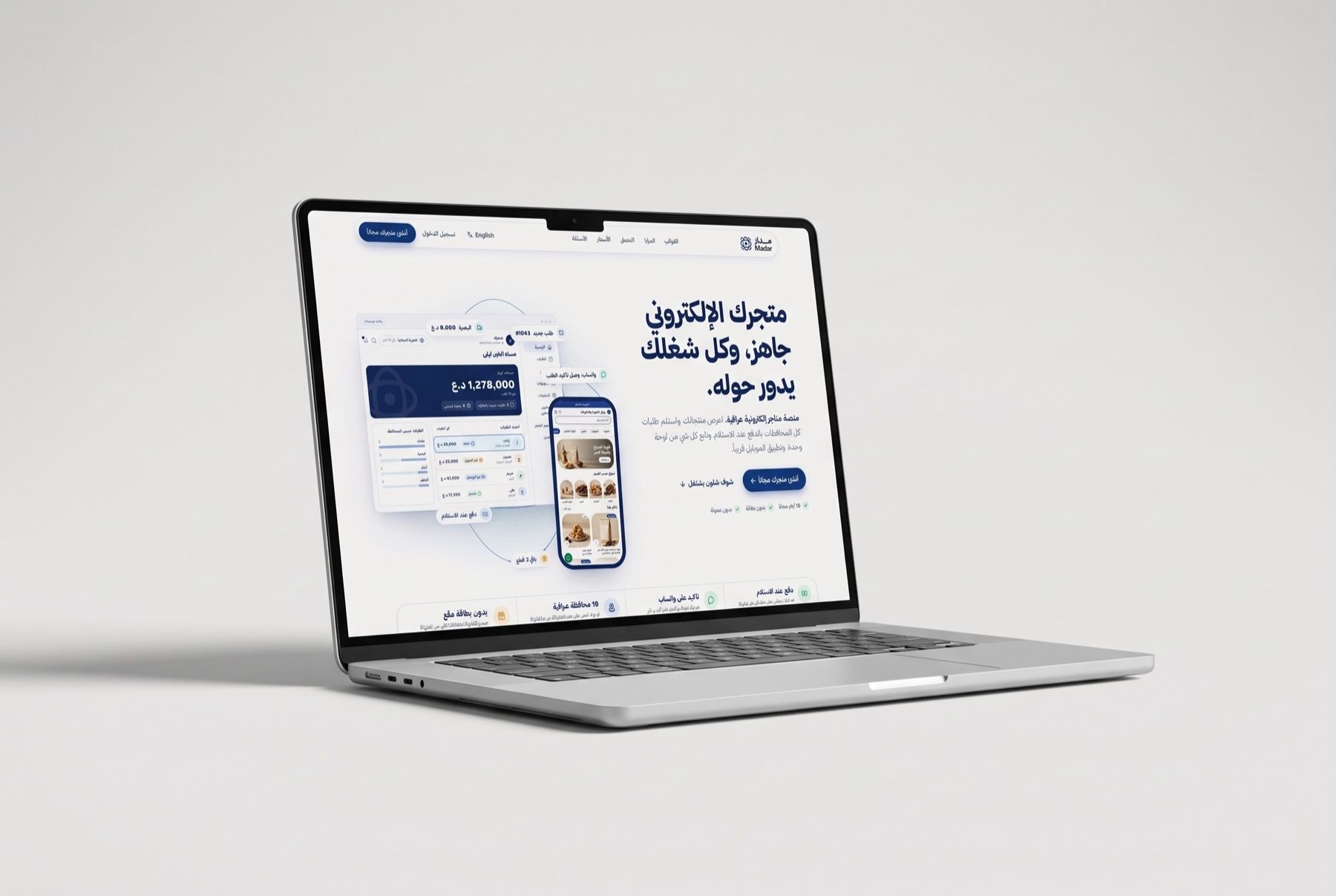
 Online store platformMadarA platform on which an Iraqi merchant opens a store and manages orders, delivery and the collection of money from one place.

How to start without leaving Instagram
Instagram is the shop window. The store is the ledger and the storeroom.
The way I recommend is simple. The merchant puts the store link on their page and starts with only their twenty best-selling products. Each order that comes in through chat is entered into the store, so that it gets a number and a status, until this becomes a habit.
After a few weeks, once the reports show them what they used to estimate by instinct, they start sending customers straight to the link. That decision does not have to be made on the first day.
There is another side to the problem, and that is the messages themselves: who replied, who forgot, and which conversation would have become a sale. I am working on a separate product called Enjazo that gathers WhatsApp, Instagram and Telegram messages in one inbox. It is before the trial stage, so I will not judge it here.
The platform watches who is struggling
One small decision in Madar shows how I think. The platform’s admin dashboard has an activity score for each store, from zero to a hundred, and an early warning when a store starts to drift away. A platform that lives on the merchant’s subscription only lasts if the merchant does, so we want to know who is struggling before they leave without a word.
Three questions before you choose any store platform
I do not mean Madar alone. Put these questions to any provider, and ask for the answers in writing.
Ask before you move your store
These three questions have nothing to do with design, but they decide who owns your business a year from now.
The short version
Iraqi merchants sell by chat because it fits the way people buy. What they lack in order to grow is an order with a number, stock they can count on, priced delivery and cash they can track, all on their phone. Build them a tool in that order and they will grow without giving up the way they started.
Projects mentioned in this article


Questions
Should a merchant leave Instagram when opening an online store?
No. Instagram remains the shop window and the place to meet customers, and the store becomes the place for orders, stock and delivery.
Why is cash on delivery important in Iraq?
Because it is what many buyers are used to. That is why we made it the first option in Madar, along with tracking of the cash each courier holds.
Is Madar running now?
Yes. The platform runs with its storefront, merchant dashboard and phone app, and a demo version is available to try with real stores. I do not publish merchant results until there are results to publish.
Does a merchant need a computer to run the store?
They should not need one. Many merchants run their business from a phone, so the dashboard and the phone app were designed together.